Introduction
More Than Magnolias and Jasmine
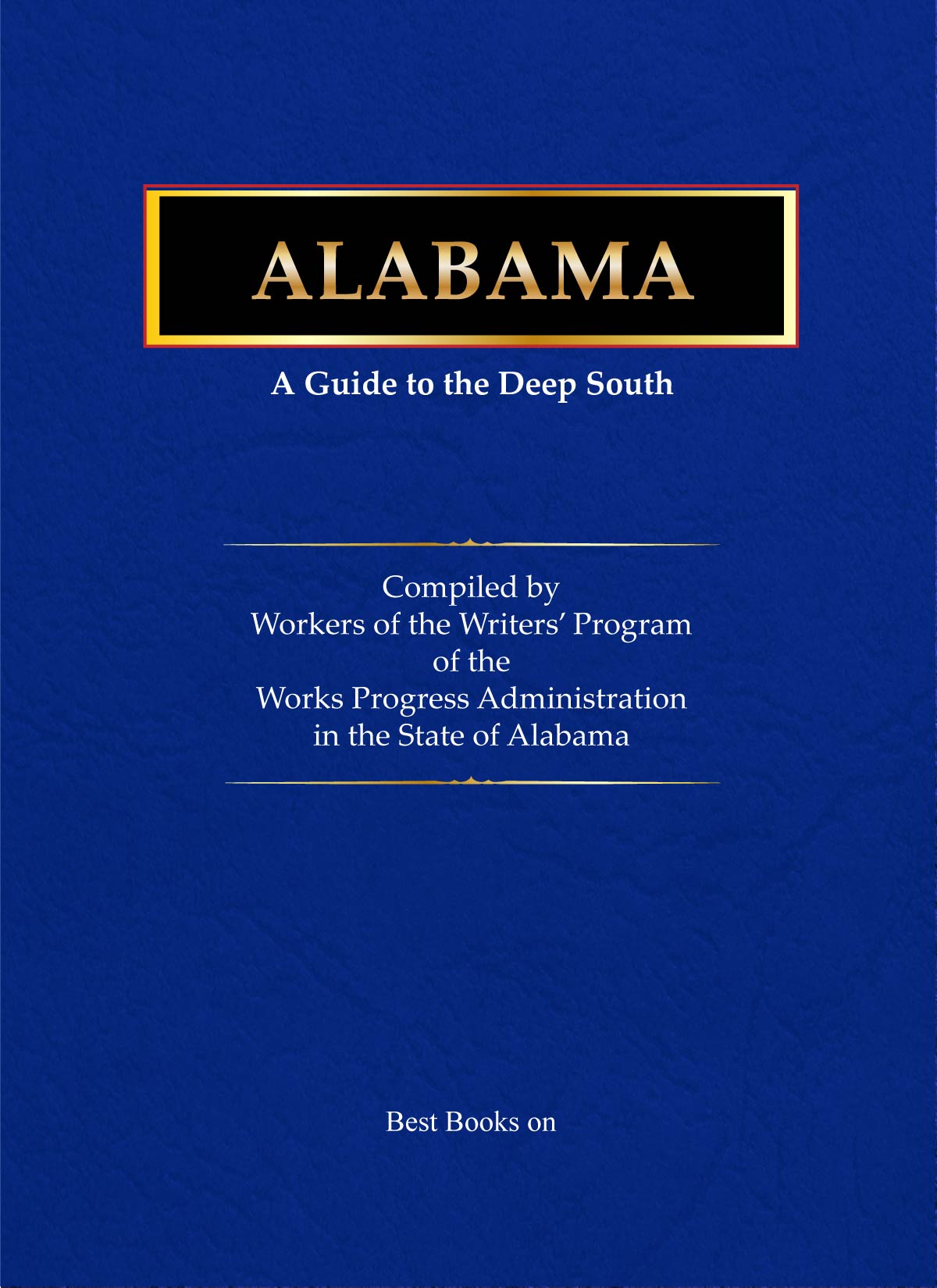
Fiction had already made lavish use of Alabama before the Writers’ Project arrived to document it — the magnolias and jasmine, the dialects and folkways, the plantation houses, even the red ore and coal tipples that fed Birmingham’s furnaces. Yet as the guide’s own preface observes, the state remained unfamiliar ground to the vacationing tourist, and Alabamians themselves often knew too little of their homeland’s scenery, history, and development. Alabama: A Guide to the Deep South, prepared by the Alabama Writers’ Project as a unit in the American Guide Series and first published in May 1941, set out to close that gap with a single volume that no earlier book had matched in scope.
The editors were candid about both the difficulty and the method. Space limitations, they admitted, precluded completeness, and human frailty prevented perfect accuracy in every instance — but the book’s virtue, they argued, lay in being a product of many minds, a mosaic of countless items. People as well as books were consulted; many thousand miles of road were traveled; homes and factories, bayous and mountain gorges were visited in gathering the material. The result was an exercise in cooperative effort, aided by state departments, federal agencies, chambers of commerce, and public and private libraries, with the Pennsylvania Writers’ Project lending a hand to complete the maps. Governor Frank M. Dixon contributed a foreword, and the whole was sponsored statewide by the Alabama State Planning Commission.
The guide is organized into four parts. Part I, “Past and Present,” gathers essays on Alabama old and new, its natural setting, its first peoples, and its history, followed by surveys of industry, agriculture, transportation, education, religion, the press, sports, folklore, literature, music, the arts, and architecture — a social portrait of the state rather than a mere catalog of sights. Part II, “Courthouse Squares,” profiles eleven cities from Anniston and Birmingham through Mobile, Montgomery, and Tuscaloosa. Part III lays out fifteen numbered automobile tours, with lettered sub-tours, threading the state from the Tennessee line to the Gulf and across to the Georgia and Mississippi borders. Part IV closes with a chronology, a bibliography, the 1940 census figures, and an index.
A note on the numbers: when the guide went to press, 1940 population figures were available only for the larger cities, so the tour descriptions rely on the 1930 census, with a complete alphabetical list of the 1940 figures supplied in the appendices. Read today, the volume is at once a practical period guidebook and a primary historical document — a record of Alabama as its own writers saw it on the eve of the Second World War, before the interstate highways and postwar industry reshaped the landscape it so carefully describes.
Contents
Table of Contents
Library Record
Full Bibliographic Record
- Title
- Alabama: A Guide to the Deep South
- Author
- Compiled by Workers of the Writers’ Program of the Work Projects Administration in the State of Alabama (Alabama Writers’ Project)
- Series
- American Guide Series
- Sponsor
- Alabama State Planning Commission (A. J. Hawkins, Director)
- Foreword
- Frank M. Dixon, Governor of Alabama
- Publisher
- Richard R. Smith / Hastings House, New York
- Publication Date
- First published May 1941 (this copy: Second Printing, June 1949)
- Description
- xxii, 442 p., 64 unnumbered pages of plates: illustrations, maps; folded map (“Alabama Tours” / resources map) in rear pocket; 21 cm. Includes bibliography (p. 413–423), 1940 census figures, and index.
- OCLC Number
- 38502028 (WorldCat record)
- Subjects
- Automobile travel — Alabama — Guidebooks; Alabama — Description and travel; Alabama — History; Alabama — Guidebooks
View this title’s full catalog record on WorldCat.org.
Read Online
Preview the Full Text
The complete 546-page volume, free to read. If the preview does not load in your browser, open it on the Internet Archive or use the Read for Free button above.