Introduction
The Spirit of Oklahoma
“Oklahoma is a land of timbered mountains, treeless plains, mesquite and sage brush, cypress and pine, massive buildings and small homes, of pioneer newness and old tradition,” wrote W. B. Bizzell in his foreword. “Within its boundaries is found nearly everything that we think of as genuinely American.” Clear fishing streams and rugged mountain scenery, level plains of grain, remote ranch houses and great cattle herds, oil-field derricks and skyscraper cities — all of it, he argued, revealed the enterprise and hospitality of the men and women whose achievements make up the substance of this Guide.
Bizzell’s central paradox gives the book its character. “In one sense, Oklahoma is new, but in another real sense it is old.” There were people living in the state whose memories spanned its whole history: pioneers who had driven the first stakes to plat the townsites, delegates who had sat in the constitutional convention, and members of the Five Civilized Tribes who had governed small Indian republics “as distinct and individual as city states of ancient Greece.” The first church was organized in 1830, the first school law enacted in 1832, the first printing press set up in 1835, and the first newspaper begun in 1844 — agencies of civilization established by and for the Indian population, on which the state’s later economic, social, and political life was built.
The editors, Angie Debo and John M. Oskison, were candid about their ambition. Working over the material gathered by the Oklahoma Writers’ Program, they confessed they sometimes suspected they were assembling the most comprehensive history of Oklahoma yet published. The obvious purpose of a state guide, they noted, is to direct — the tours and the section on principal cities try to tell accurately what every nook and corner of Oklahoma holds for the citizen and the visitor. But beyond the search for facts, the staff sought whatever would add color to the state’s story, and kept always in mind the need to make clear the close human and political contacts between Indians and whites in the century and a quarter since the two peoples first met.
From those aims the volume takes its three-part shape. Fourteen background essays open the book — beginning, fittingly, with Edward Everett Dale’s “The Spirit of Oklahoma” — and survey the natural setting, the early Oklahomans, history, industry, agriculture, education, literature, music, and folkways. Twelve principal cities follow, from Ardmore and Bartlesville to Tulsa. Then come sixteen numbered motor tours with their lettered branches, threading the state from the Kansas line to the Red River and from the Arkansas border to the high plains of the Panhandle. Sponsored by the University of Oklahoma and published at Norman in 1941, the book remains a serious and rounded portrait of the Sooner State.
Contents
Table of Contents
Library Record
Full Bibliographic Record
- Title
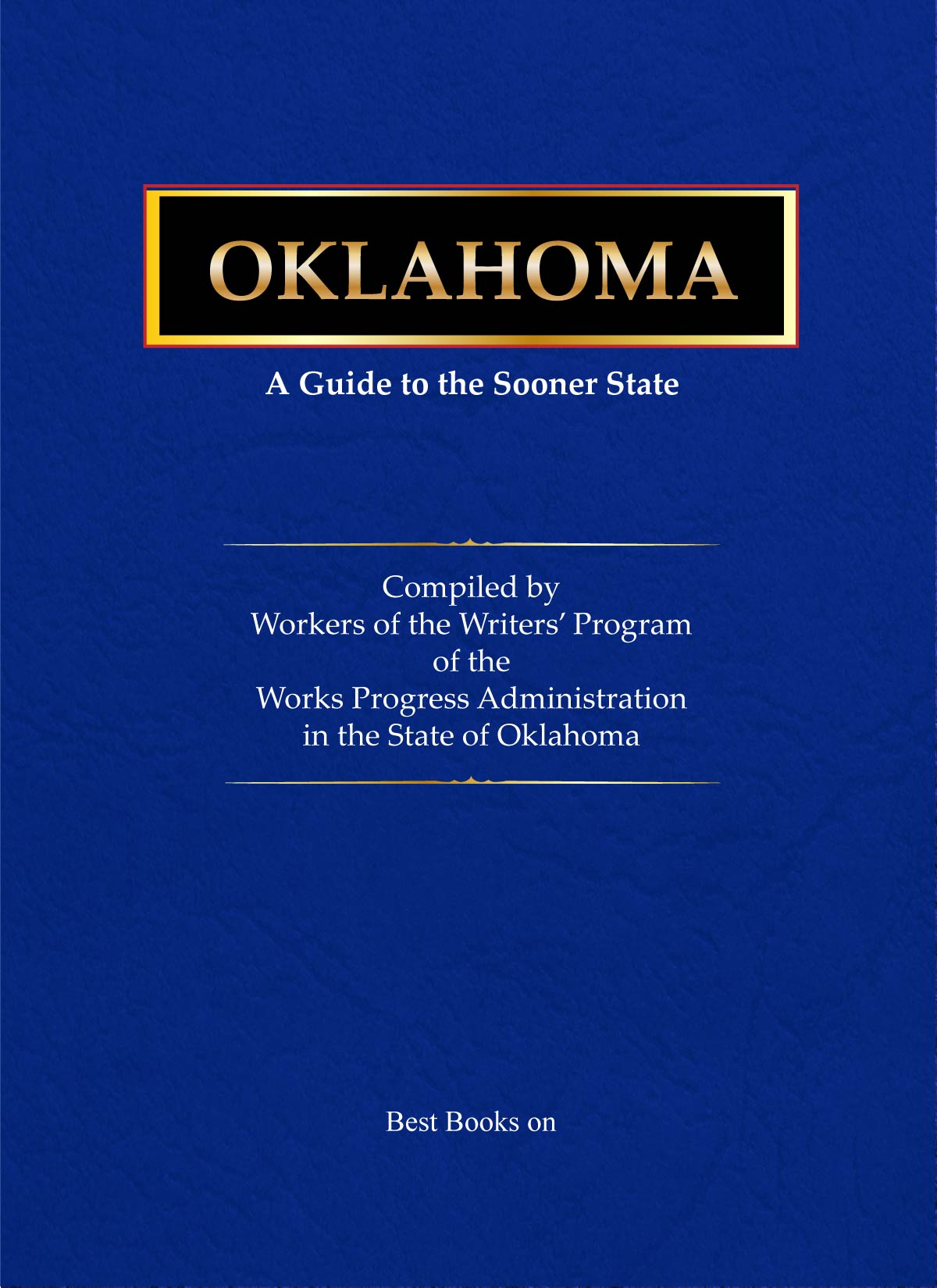
- Oklahoma: A Guide to the Sooner State
- Author
- Compiled by Workers of the Writers’ Program of the Work Projects Administration in the State of Oklahoma
- Series
- American Guide Series
- Sponsor
- The University of Oklahoma (state-wide sponsor of the Oklahoma Writers’ Program)
- Foreword
- W. B. Bizzell, President, University of Oklahoma
- Editors
- Angie Debo and John M. Oskison
- Publisher
- University of Oklahoma Press, Norman
- Publication Date
- Copyright 1941 by the University of Oklahoma
- Description
- Front matter through xxiii; main text beginning at page 3; fourteen background essays, twelve city descriptions, and sixteen motor tours. Illustrated; tour maps. Includes chronology (415), selected reading list (422), and index (427).
- Subjects
- Automobile travel — Oklahoma — Guidebooks; Oklahoma — Description and travel; Oklahoma — History; Oklahoma — Guidebooks
View this title’s catalog record on WorldCat.org.