Introduction
A Fadeless Film of a Civilization
The Oregon Guide, its preface declares, is the product of many hands and minds working joyously, without hope of individual reward or recognition. The members of the Oregon Writers’ Project spoke, as they put it, collectively and anonymously — carpenters of language with words as tools, finding facts and fashioning them into sentences and chapters. They worked, moreover, in faith that the book would outlast its first usefulness: long after the best road of the day had been supplanted and the highest building had crumbled, this volume would remain “a treasure trove of history, a picture of a period, and a fadeless film of a civilization.”
“It was easy to write about Oregon,” the writers admitted, for the state inspires not provincial patriotism but affection. California has climate, Iowa has corn, Massachusetts has history, and New York has buildings and money and hustle and congestion — but Oregon, that “lovely dappled up-and-down land,” has an ever-green beauty as seductive as the lotus of ancient myth. Even the newcomer succumbs: soon he speaks of Mount Hood as “our mountain” and looks for a home-site from which to view it. Governor Charles A. Sprague, in his foreword, called the book the major accomplishment of the Oregon Writers’ Project — more than a conventional guide, an attempt to present the history and heritage of the state as well as its scenery, and to portray Oregon not only to visitors but to Oregonians themselves.
The preface does not flinch from Oregon’s future. Only a few short years, it muses, separate the day when Bryant wrote of the primitive country “where rolls the Oregon and hears no sound” from a present in which Bonneville Dam has cut a gash in the Columbia Gorge and Grand Coulee looms to the north. Oregon remained, the writers believed, the most unspoiled and uncluttered spot in America — spared by the gold rushes that drew the restless to California and Alaska — yet they wondered aloud whether power, immigration, timber-cutting, and the boosting of commerce might transform this peaceful land into a network of highways clogged with cars and hot-dog stands.
Out of those hopes and misgivings the book takes its shape. Part I, “Past and Present,” gathers eighteen essays on the natural setting, the Indians, history, agriculture and industry, racial elements, religion, literature, and such local savors as tall tales, huckleberry cakes, and venison. Part II describes eleven cities and towns, from Astoria and Portland to The Dalles. Part III, “All Over Oregon,” lays out ten numbered tours with their many lettered branches, reaching every corner of the state and closing with the Mount Hood Recreation Area, Crater Lake National Park, and the national forests. Sponsored by the Oregon State Board of Control and published at Portland in 1940 by Binfords & Mort, it remains a loving and clear-eyed portrait of the end of the trail.
Contents
Table of Contents
Library Record
Full Bibliographic Record
- Title
- Oregon: End of the Trail
- Author
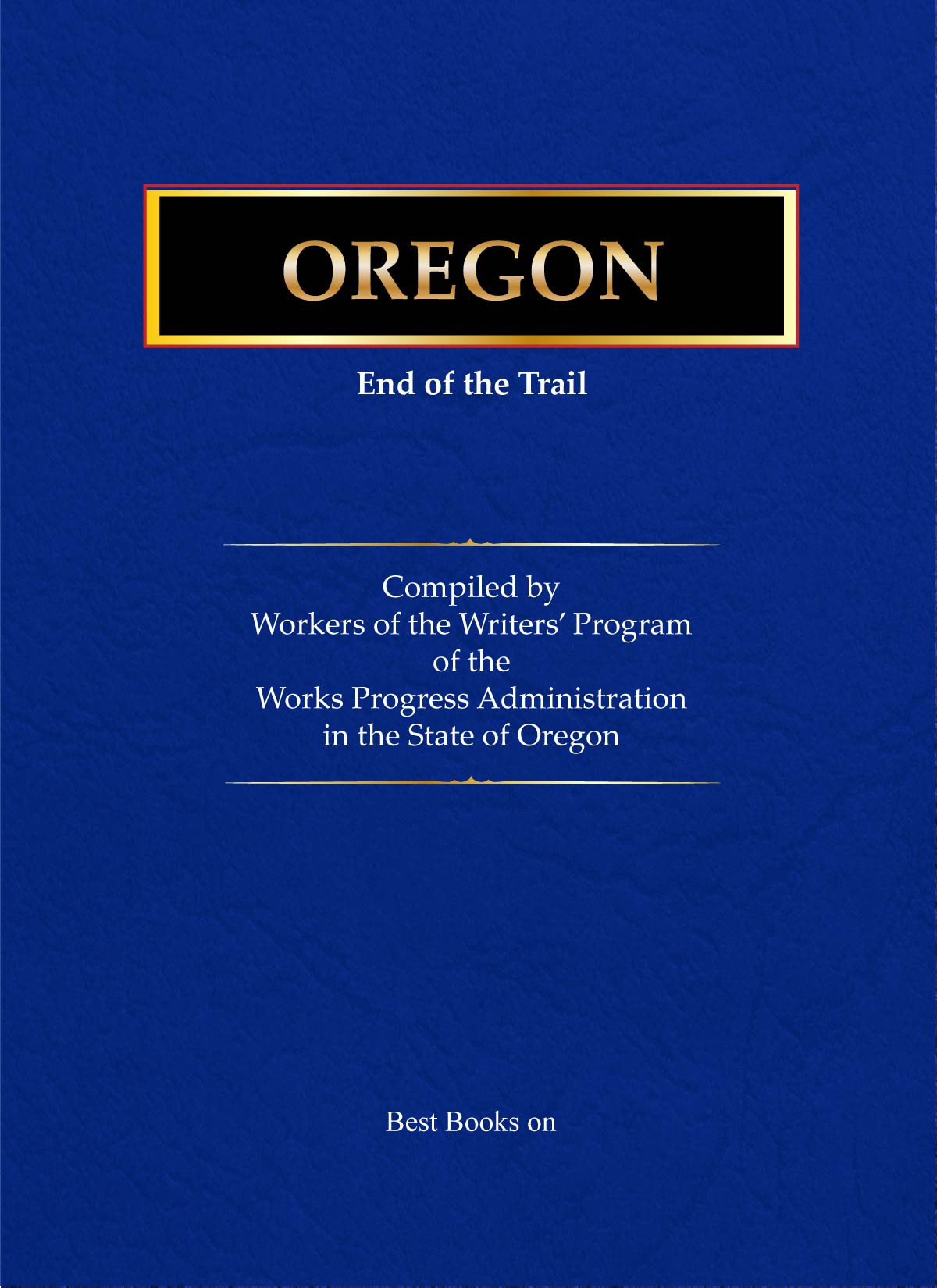
- Compiled by Workers of the Writers’ Program of the Work Projects Administration in the State of Oregon
- Series
- American Guide Series
- Sponsor
- Oregon State Board of Control
- Foreword
- Charles A. Sprague, Governor of Oregon
- Publisher
- Binfords & Mort, Portland (printed by the Metropolitan Press)
- Publication Date
- Copyright 1940 by the Oregon State Board of Control
- Description
- Front matter through xxvii; main text beginning at page 3; eighteen background essays, eleven city and town descriptions, and ten motor tours with lettered branches. Illustrated; tour maps. Includes chronology (521), a select reading list (529), and index (536).
- Subjects
- Automobile travel — Oregon — Guidebooks; Oregon — Description and travel; Oregon — History; Oregon — Guidebooks
View this title’s catalog record on WorldCat.org.